Introduction
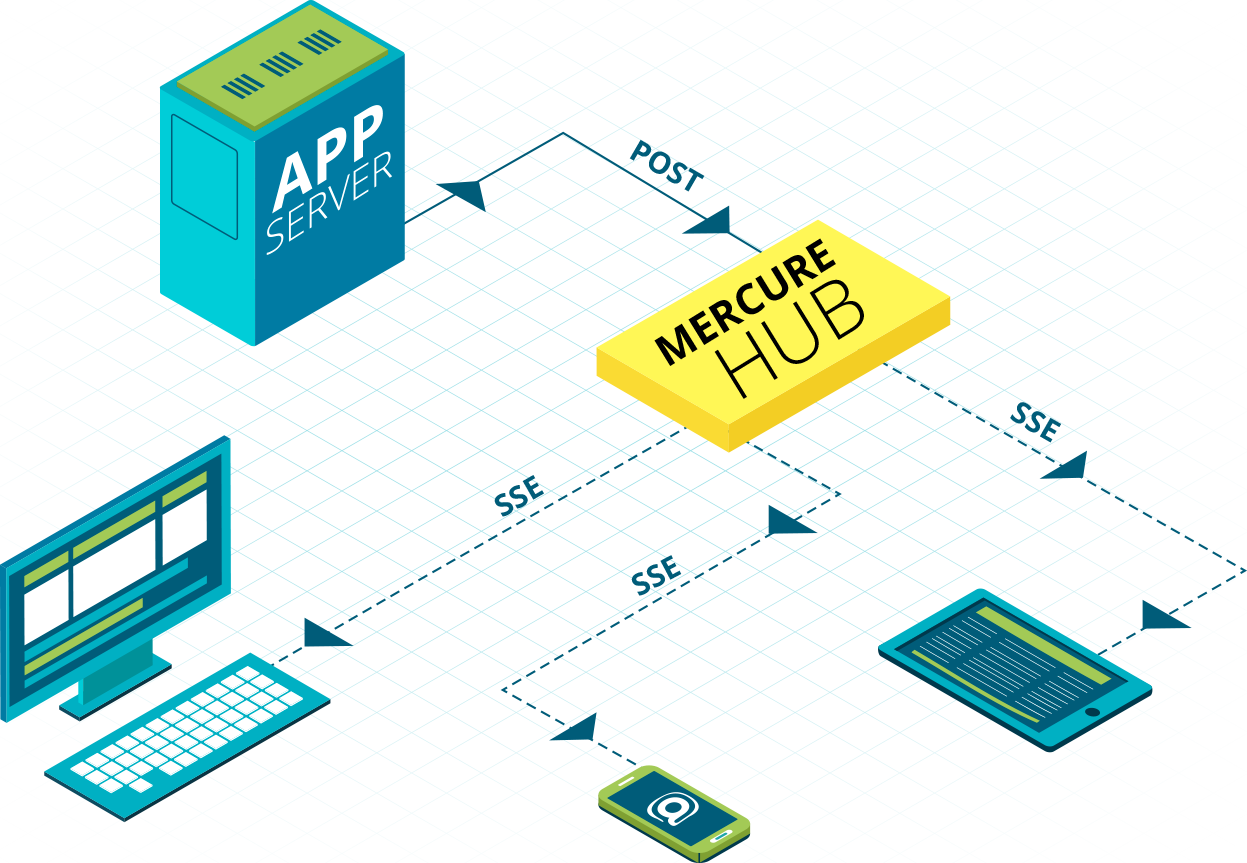
Mercure pushes data from a server to connected clients in real time, over plain HTTP. It's a thin protocol on top of Server-Sent Events, with a JWT-based authorization layer and a reconnection model that handles dropped connections without losing messages.
If you've ever wired up a WebSocket server just to push notifications, sync a UI, or stream tokens from an LLM, Mercure is the smaller thing you wanted instead.
#What you get with Mercure
- Native browser support. No SDK. The
EventSourceAPI ships in every modern browser; on the server, any HTTP client can publish. - HTTP/2+ multiplexing. One TCP connection carries every subscription a client opens, plus the rest of your app traffic.
- Built-in reconnection and replay. Clients reconnect automatically and resume from the last event they saw. The hub's history buffer fills the gap.
- JWT authorization. Sign tokens with the matchers a publisher or subscriber is allowed to use. The hub enforces them.
- Hypermedia-friendly. Topics are URLs. The protocol works with REST, GraphQL, JSON-LD, and HTML over the wire (Hotwire, htmx).
- Encryption support. Updates can be JWE-encrypted end-to-end, so even the hub operator cannot read them.
#What it's good for
- LLM streaming. Stream tokens or tool calls from a server-side model invocation to the browser as they arrive. (Guide)
- AI agent progress. Push agent state to the UI: "searching the web", "reading file", "ran 3 tools, summarizing". (Guide)
- Live data. Stock tickers, availability, IoT telemetry, dashboards. (Guide)
- Collaborative editing. Several users edit the same document; changes broadcast to everyone connected. (Guide)
- Async jobs. A worker computes a report; the result lands in the UI when ready. (Guide)
- Notifications. In-app toasts, mentions, mailbox counters. (Guide)
#How it differs from the alternatives
vs. WebSockets. WebSocket is a low-level transport; you still need to design framing, authorization, reconnection, replay, and presence. Mercure gives you all of that on top of HTTP/2, which most infrastructure already understands. For request/response inside the same connection, just use a regular POST: HTTP/2 already multiplexes it.
vs. Pusher / Ably / Firebase / Supabase Realtime. These are SaaS-only. Mercure is a protocol with an open-source reference hub: you own the data and the connections, and you can run it on your own infrastructure if compliance demands it. The free Mercure.rocks Hub has unlimited connections and an unlimited history buffer, bound only by the hardware you give it.
vs. WebSub. WebSub is server-to-server only. Mercure does server-to-server, server-to-client, and client-to-client over the same primitive.
vs. Web Push. The Push API targets offline devices through vendor servers (Apple, Google, Mozilla). Mercure targets connected clients with no third party in between and no payload-size limit.
See the FAQ for more.
#The free version is the production version
The Mercure.rocks Hub is licensed under AGPL-3.0. Concretely, that means you can:
- Run it on your own infrastructure with no connection limit, no message-rate limit, and no buffer cap other than disk size.
- Use it in production behind any HTTP/2 or HTTP/3 reverse proxy.
- Build any kind of application on top of it, commercial or otherwise. The AGPL applies to modifications of the hub, not to your application.
There are paid tiers (Cloud for managed deployments, Self-Hosted for multi-node and premium transports), but the free tier is not crippleware. It's what runs the demo hub, what powers production deployments at companies pushing tens of millions of updates a day, and what you should reach for first.
When you outgrow a single node, the production guide explains the options.
#Where to go next with Mercure
- Quickstart: running hub, first subscription, first update.
- Topics and matchers: the part of the protocol that changed most in 1.0.
- Read the specification: also published as an IETF Internet-Draft on track for RFC publication.